
The main objectives of the ION4PV: ION4PV: LCA projects are to develop new encapsulants for photovoltaic modules and to assess the costs and impacts caused and/or avoided by these new materials.
In the ION4PV project, we have explored a two-pronged approach to improving SLS glass for photovoltaic modules, aiming for enhanced optical performance and a longer service life:
- Inclusion of surface K+ ions via chemical doping, where the larger K+ ions block the movement of Na+ and prevent it from escaping the glass and contaminating the solar cell via the potential ionic degradation (PID) mechanism
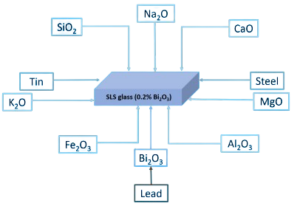
- Inclusion of Bi2O3 for more efficient UV filtering and increased durability of the solar cell and plastic encapsulants.
A detailed life cycle assessment (LCA) study has been carried out in accordance with ISO 14040 and ISO 14044, including a detailed life cycle inventory (see Figure 3 for the main substances involved in the manufacturing process of the proposed new glass composition). The LCA provides a comprehensive environmental assessment of the improvements achievable with the proposed approaches to ‘photovoltaic glass’ production methods.

ION4PV is a research project comprising two sub-projects, both awarded by the Ministry of Science and Innovation as part of the Recovery, Transformation and Resilience Plan, and funded by the European Union (NextGenerationEU).
Antonio Urbina and Vicente Sánchez-Alarcos lead the main project from the Public University of Navarra, whilst Lucía Serrano-Luján leads the “ION4PV-LCA” sub-project from Rey Juan Carlos University.
The codes for both projects are: TED2021-132368B-C21 and TED2021-132368B-C22.